

WordPress Still Worth it in 2026? The Answer is…
TL;DR
- It’s still alive!
- WordPress has been around for a long time. Since users have been familiar with CMS for over 20 years, it’s not really easy to move to a different CMS or ecosystem.
- WordPress CMS is free and gives you control over your website. Also, the community is bigger compared to other CMS platforms.
- 60,000 + plugins from publishers are available for free, making it easier to build a custom solution
- Still dominating the trends in searches for building custom solutions. However, other CMS like Wix and Squarespace are catching up
- Building scalable e-Commerce platforms is still dominated by WooCommerce
- AI is one of the key reasons for the drastic change in CMS trends and usage
- A new CMS with better usability can become a problem in the future for WordPress
- Plugin fatigue is real because of the rapidly changing ecosystem
- 2026 may be the year of WordPress. But still, AI is reshaping the future. It remains to be seen whether WordPress will survive in the coming years.
Yes, WordPress is still alive and kicking in 2026. In my opinion, it’s still worth it.
But what will happen in 2027 and beyond, that still remains to be seen.
However, the question is: why is WordPress still relevant in 2026? Especially when Artificial Intelligence is so dominant?
The answer, I’m afraid, is not so simple. There are quite a few factors in play here.
Why is WordPress still worth it in 2026?
The number one fact, in my opinion, is human nature. Humans, because of how you and I think, are quite resistant to change.
WordPress has been around for a while
WordPress has been around since 2004. Things back then were BLEAK. The state of designing a website was TOO fundamental compared to today’s standards.
It’s been over 2 decades since the CMS has been around. And while it’s been around, people have been spoiled by it.
Let me explain.
In 2025-2026, the way of building websites is faster, a lot faster. The evolution of the internet and CMS systems like WordPress is very mature.
And, if you see the numbers, over 42% of websites are still powered by WordPress according to W3Techs. So, it is safe to say that almost HALF of all the websites are powered by WordPress still!
Although the number is dominant compared to other CMS offerings like WIX, Squarespace, etc., it is declining, unfortunately. Much of it, I think, is because of Artificial Intelligence (AI).
Early adopters, of course, are already on the hype train – building websites and systems with ChatGPT, Claude, Gemini, etc.
This is actually a very relevant discussion. I urge you to check it out.
However, people are still reluctant to change. Again, it’s the human thing!
People who are already familiar with the interface will need time adapt. Especially those who are running eCommerce websites will retaliate. Because moving a running business from one platform to another is a HASSLE.
Again, the structure is simply hard to fight! Users are familiar with the WordPress-like system.
And it’s hard to move away from it.
You Control Everything
That’s the beauty of WordPress. You are in control.
WordPress gives you the system; you are in control of building everything. You have control over the data, your content, everything.
It’s an open system. And it can definitely help you scale.
The Community is there to help
In the CMS space, the WordPress community is the largest. And it is very active. Communities for other CMS are growing.
Still, the existing community power of WordPress is dominant.
However, in the coming years, the landscape will change!
Healthy Library of Plugins
Over 60,000 free plugins are available for users to check out, completely free of charge!
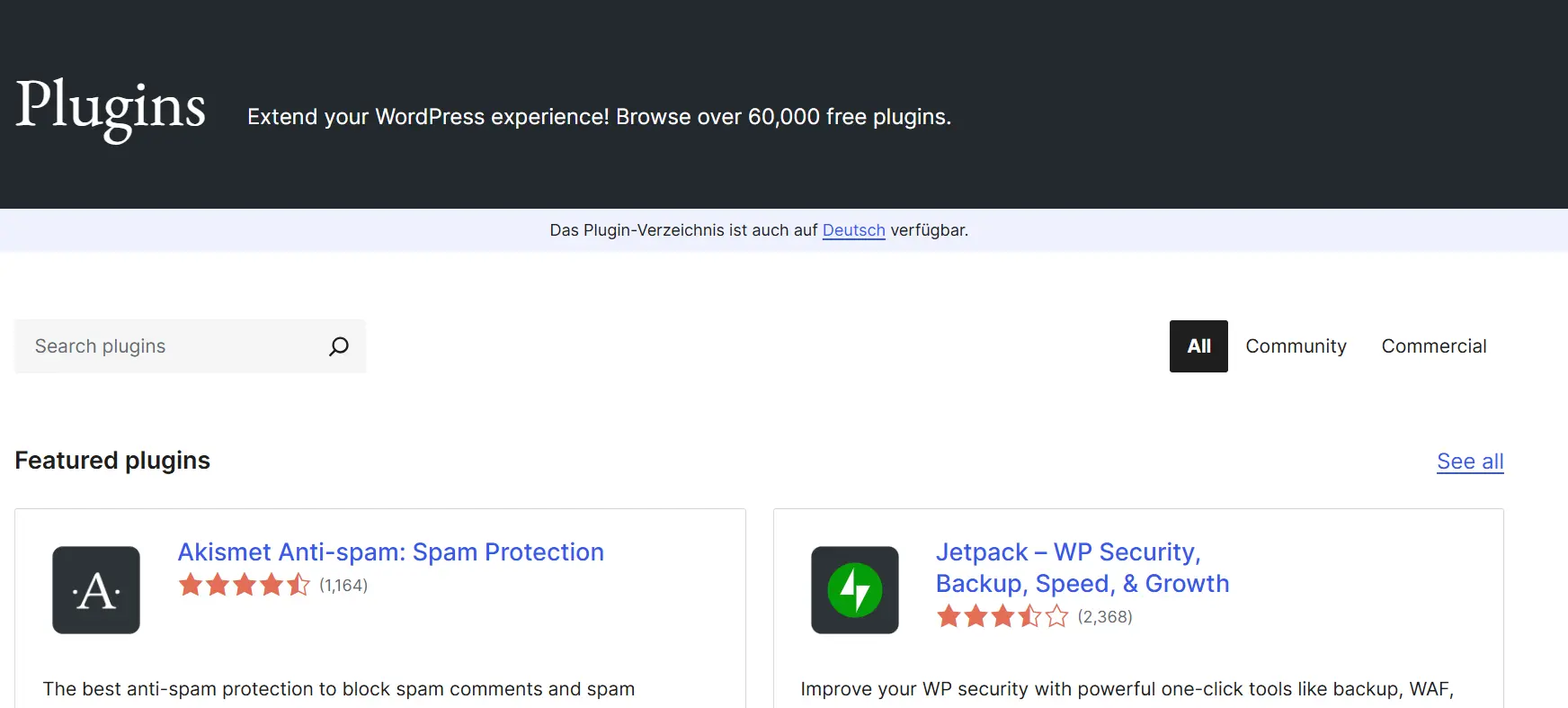
And the plugin market is growing. I did a search using the phrase “WordPress Plugin Growth” on Google.
The AI overview revealed that the plugin submission for review grew by 2X. It’s an 87% increase.
So the bottom line is, there’s no shortage of tools for building a fully ‘personal’ system.
Still Dominating Trends
Search trends go to show that WordPress is still among the top trends in the CMS space.
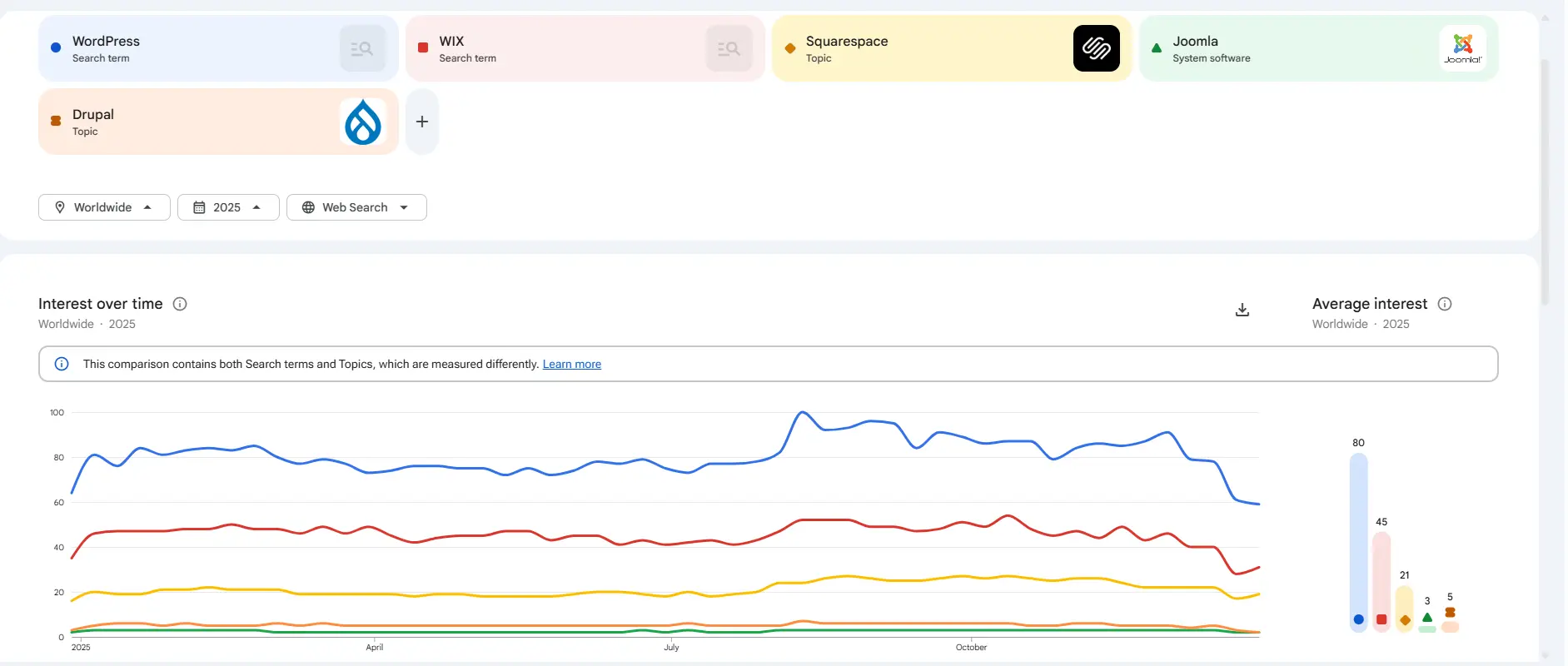
However, options like WIX and Squarespace are growing slowly. But, in 2026, WordPress is on top.
However, 2026 will be a crucial year for WordPress. WordPress v7.0, scheduled for release this year, holds promise.
It all comes down to how users accept and adapt to the newer promises.
Building at Scale: Still Relevant for E-commerce
WordPress still dominates the e-commerce space. 4.6 million users are using WooCommerce for their online stores.
That’s not a small number. Compared to Shopify, you can call it ‘free’. But the thing is, when you go to scale, it becomes expensive.
So, looking at the big picture, Shopify is still the better platform. But WordPress is open-source and free to use. It’s one of the reasons why it’s still popular.
In my opinion, starting out with an open system still has its merits. This makes WordPress suitable for building businesses online on a smaller scale.
Again, it all depends on how the platform grows and how the change gets adopted by the users of the community.
This video may be a bit old. But there are some great insights in here as well:
Now, here are some questions I think are quite relevant to the scenario. However, if there’s anything you’d like to know, sound off in the comments below:
What if a new CMS comes to the market? What happens then?
Now that is a genuine concern.
“A Structured CMS” – it’s what makes WordPress a CMS that almost anyone can use. However, you simply can’t overlook the fact that it is still a bit hard to get around. Especially, the Gutenberg system.
And there’s a good chance that platforms like WebStudio could go ahead and offer an easier experience.
So, there is a chance of change. But it is quite hard to say how users will adapt to it.
What I can say is that early individuals may think of moving to the new platform. Older, more established sites may need another 2 or 3 decades to adapt!
Is plugin fatigue real?
It’s real, alright.
I mentioned earlier that the plugin market is growing. Publishers are ‘spitting’ out plugins way faster. That’s a good thing.
There’s competition in the market.
However, the competition is a bit too much! Users are simply not sure where to invest. In a sense, there’s more supply than demand.
And that has led to ‘Plugin Fatigue’.
I believe this is partly because of AI. AI made building solutions faster. This new power leads to building solutions faster.
Is the current market growth good for the user?
I don’t think it is.
The way the tech market is growing – it’s not good for the users. It’s good for the businesses out there.
And that’s a big problem. From what I say, it’s more about ‘pushing products’ than offering ‘solutions to problems’.
Building genuine solutions, in my opinion, is getting ‘rarer’. And, this might come back to bite the community in the back if it’s not moderated in some way.
Security is still a big concern – Will it have an impact?
This has been an existing problem in the WordPress ecosystem. Plugin security has been one of the core reasons for optimal scalability.
They do recommend keeping the plugins up to date. However, many users don’t tend to do so in fear of losing their data or structure.
So, yes, the security issue is certainly a thing.
However, there are plugins out there that can help with improving the security. And keeping the plugins up to date is always recommended.
And publishers should comply with the WordPress ecosystem and push out security updates accordingly.
There’s definitely room for improvement here. It falls on the users, publishers, and WordPress to tackle the situation for building large-scale platforms.
That being said, here are my final thoughts:
WordPress is still worth it in 2026. But there are caveats. The rapidly changing tech industry, because of AI, is the prime concern. Another key point of concern is plugin fatigue. I think this will be a more pressing problem for general users.
How the community reacts to this change remains to be seen.
